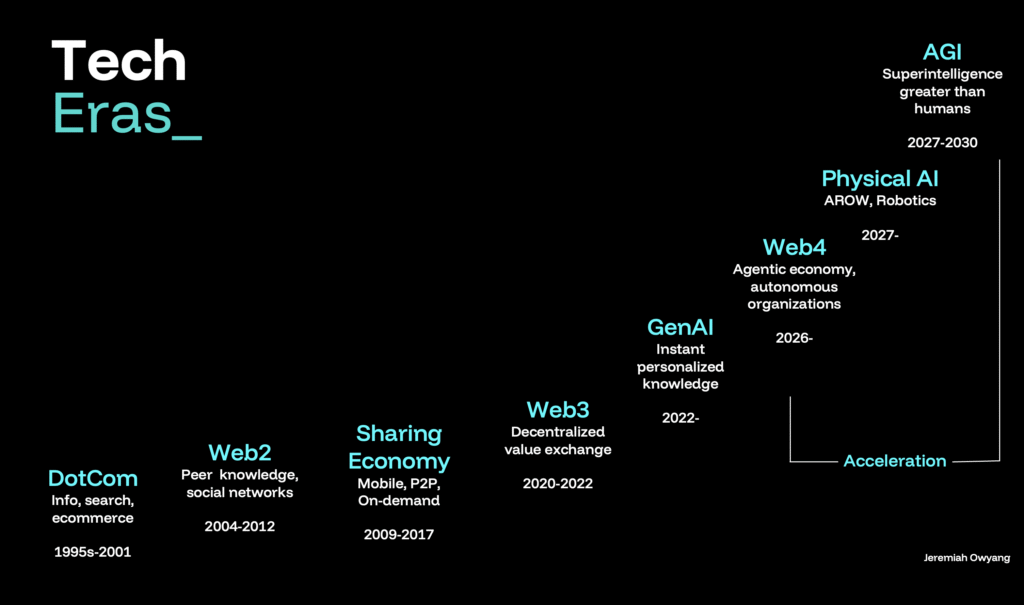
The tech industry has moved through distinct waves over the past few decades.
- DotCom enabled information, search, and ecommerce.
- Web2 created peer knowledge and social networks.
- The sharing economy digitized services through mobile and on-demand models.
- Web3 introduced experiments in decentralized value exchange.
These waves mattered. But they all shared one constraint: humans were the bottleneck. We created the content. We drove the networks. We operated the marketplaces. Progress moved at the speed of human adoption.
That’s changing now. GenAI broke the dependency on human-paced scaling. Agents can generate knowledge, coordinate tasks, and improve workflows continuously, without waiting for us. Growth becomes less constrained by labor, and more constrained by compute, energy, and capital.
- Moltbook, which I invested in and was later acquired by Meta, launched social networks for AI agents.
- Polsia shows how individuals can orchestrate fleets of agents to build and scale micro-SaaS companies.
- Feltsense (investment)is developing systems where agents support enterprise decision-making.
- Clawmart is experimenting with agent-driven commerce models.
These are early examples of agent-native systems, where AI interacts directly with other AI systems rather than being mediated solely through human interfaces.
The implications extend beyond software. The next phase is Physical AI, and AROW (Agentic Robotics Orchestration Workflows), where agent orchestration connects to robotics and real-world operations. This is where intelligence begins to reshape supply chains, manufacturing, infrastructure, and daily life.
Further out, industry leaders are increasingly discussing timelines for AGI. At Davos, representatives from Google DeepMind and Anthropic referenced the possibility of superintelligence emerging within the late 2020s. Whether those dates prove accurate or not, the broader trajectory is becoming clearer.
Technology innovation and adoption are no longer dependent on humans, as agents are building software, controlling hardware, and adopting technology.
